Since it began in 1983, Frontline has been airing public-affairs documentaries that explore a wide scope of the complex human experience. Frontline's goal is to extend the impact of the documentary beyond its initial broadcast by serving as a catalyst for change.
Jessica Savitch's first and only season as on-air host. She died in a car accident in October.
EP 1
EP 1
1. An Unauthorized History of the NFL
Jan 17, 1983
In its premiere broadcast, Frontline investigates the underbelly of the NFL--the secret connections between professional football and the world of sports gambling and organized crime.
On the morning of November 3,1979, five civil rights demonstrators were killed by a group of Klan and Nazi Party members in Greensboro, North Carolina. Correspondent James Reston, Jr.,investigates the role of a police informant who was with the group when the attack was planned and when it was carried out.
Frontline correspondent Charles Cobb journeys to a Washington, DC that tourists rarely see. The nation's capital, seventy-five percent black, faces widespread poverty, yet it is run by some of the civil-rights movement's most effective and militant organizers, including Mayor Marion Barry.
For thirty-four years, those who fled to Taiwan in the wake of the Communist victory have had only their memories and fantasies of mainland China. Now they want to know much more, and a political struggle is underway to determine how Taiwan will relate to the mainland.
In 1982,a man was discovered hanging from a bridge over the Thames River in London. He was Roberto Calvi, head of Italy's largest bank and chief advisor to the Vatican's bank. Reporter Jeremy Paxman investigates Calvi's links with the Vatican and with P-2, a secret Italian society, and questions whether his death was really a suicide.
Frontline investigates the power of the Pentagon as a business and economic force in the domestic economy. Politicians find themselves chasing Pentagon dollars for the jobs those dollars create in their districts; scientists and universities find themselves dependent on the military if they want to do research in many high-tech areas.
Frontline looks beyond the cliches and stereotypes in the debate over gun control. Visiting prison inmates, victims of gun crime, and the sharpest minds on both sides, Frontline explores the underlying fears that make gun control such an emotional issue.
Kojo Odo, a 42 year-old single black man, took in his first child a decade ago-a 7 year old boy with his arm missing. No one wanted the youngster. Each of Odo's 21 children came to him with a physical or mental handicap. Frontline looks at the daily life of this remarkable family and Odo's battle to keep the family together.
Before Gorbachev and glasnost, three young Americans journey to the Soviet Union on a whirlwind two-week, six-city debating tour. They encounter young, articulate Russians whose world view is completely contradictory to their own.
Daisy is 55 and terrified of growing old. She feels she needs a facelift. From the moment of her decision, Frontline follows her through all the procedures, but the heart of the story is an exploration of values, character, cosmetics, and the business of plastic surgery.
Before President Reagan introduced Star Wars, Frontline examined how in the previous 25 years the US and the Soviet Union had gone from designing satellites to designing weapons to blast them out of the sky. The superpowers were converting space from an arena for communications, to a concept of space as 'high ground,' the battle area to control.
For the first time on American television, Frontline's cameras record the most intimate details and one of the most personal decisions a woman can make. By focusing not only on the clinic, but also on a right-to-life doctor who pickets the clinic every Saturday, the film becomes a revealing study of people confronting their most deeply held values.
Rhodesia, a symbol of white racism, has become Zimbabwe and white minority rule has given way to black majority rule. However, the end of the guerilla war may not mean an end to fighting. Correspondent Charlie Cobb finds a rift between the nation's two black leaders that threatens to split the country along tribal lines.
Frontline investigates the frightening aftermath of one of the worst air disasters in U.S. history-the June 9, 1982 crash of Pan Am flight 759 at the New Orleans airport. The report discovers how human greed and legal machinations over hundreds of millions of dollars bring new horror to survivors and victims' relatives alike.
Only seven years after Mao's death, it is clear that China is undergoing another revolution. This is a revolution of political and social relaxation. Frontline explores what has been retained and what has been rejected from the days of the Cultural Revolution.
For eight years, Rafik Halabi covered the West Bank and Gaza strip-the only Arab reporter working in the Hebrew section of Israeli Television. This is Rafik's story-a story in which his identity and loyalty became a national controversy.
Frank Kaler's story begins simply enough when he requests a water test. Why? Because his children develop skin lesions after bathing in it. Frontline chronicles Kaler's six-year battle with local and federal officials over the chemical pollution of his drinking water.
Frontline tells the story of five days in the fall of 1982 when more than 150,000 people gathered in Washington D.C. for the dedication of the Vietnam Memorial. Parents, friends, and survivors came to the emotion-filled event reflecting the pain and conflict many still feel about that war.
When a national recreation site between Cleveland and Akron was first mandated by Congress in 1974, everyone applauded the project. But Frontline found that park policies of condemning hundreds of businesses and homes soon generated intense local opposition as well as charges that the homes of politically influential citizens were being spared.
Frontline investigates the Reagan administration's effort to remove tens of thousands of people from the Social Security disability rolls. Disabled people face personal hardship and bureaucratic indifference as they take their cases to the courts and to Congress.
In 1983, El Salvador was a nation where murder and torture were an everyday occurrence, a place where loved ones disappear and truth remains elusive. Frontline interviews government soldiers, rebels, and noncombatants to find out why the killing continues.
Frontline follows the journey of a Guatemalan family through the 'new underground railroad' and considers the plight of the people who seek refuge from governments allied to the United States.
Developing countries have borrowed hundreds of billions of dollars from Western banks. Some of the biggest borrowers, Brazil and Mexico,are struggling even to repay the interest. Correspondent Anthony Sampson finds that threats to repudiate the loans are causing American bankers to fear financial catastrophe.
Klaus Barbie, a hated Nazi war criminal, was returned to France in 1983 to face justice. But some Frenchmen were worried that he would reveal embarrassing evidence about French collaboration, and some Americans feared that he would talk about his postwar work for U.S. intelligence agencies.
Investor-owned for-profit hospital chains are aggressively marketing themselves to treat only the insured or wealthy patient. But most Americans assume government and charity programs enable everyone -- no matter how poor -- to receive treatment for serious health problems.
As American corporations begin to adopt a Japanese management style stressing worker involvement in a family-like corporate environment, Frontline looks at the darker side of Japanese labor relations at the Nissan Motor Company in both Japan and Smyrna, Tennessee.
Viewing the conflict in Northern Ireland through the eyes of Irish Americans who support the IRA and its strategy of violence. Profiles Michael Flannery, Grand Marshal of New York City's St. Patrick's Day Parade, who participated in an ambush on British troops in Ireland some 50 years ago.
Investigating whether the tens of millions of dollars raised through the appeals of television evangelists like Jimmy Swaggart goes more to doing God's work or to keeping the preachers on TV. Should the government regulate religious fundraising?
On the eve of the 1984 New Hampshire primary, the first of four national election reports. Correspondent Richard Reeves looks behind the scenes at the presidential candidates and the political reporters who cover them -- the story behind the story and who writes it.
Kenneth Bianchi, who killed two women in Bellingham, Washington, and was one of the Hillside Strangler murderers in Los Angeles, almost escaped punishment for these crimes because he convinced a group of experts that he had multiple personalities and was not mentally competent to stand trial.
A special election report focuses on Birmingham, Alabama -- famously a battlefield for black civil rights. Frontline correspondent Richard Reeves examines black political power today and the struggle for the heart and soul of the black voter.
Filmmaker Ofra Bikel takes us into the heart of El Salvador -- a tiny Central America nation about which we know so much, and yet so little -- to examine the politics and the people the U.S. government supports there.
Charlie Cobb looks at young men who make it big playing basketball, and many who will not. College recruiters promise an education in exchange for play, but 75% of players never obtain a degree. Are colleges too busy with their big-time sports programs to be concerned with educating their players?
An insider's look at the 'sport of kings' focused on tracks at Belmont, NY, where the rich indulge their interest in horse-racing, and at Great Barrington in Massachusetts where infirm horses run for purses that can barely pay the feed bill. This is America's number one spectator sport, in which tens of millions wager tens of billions every year.
Profiling Navy Secretary John Lehman and the growing debate inside the Navy establishment to build a multi-billion-dollar fleet which critics warn may not be suited to the kind of wars the nation is most likely to fight.
Explores what Los Angeles is trying to do about its gang problem. It's the worst in the nation, killing more than 1,000 people over the past three years -- the majority of whom were not even gang members.
Examines findings from a presidential commission and several private advocacy groups on hunger in America, and the extent to which they capture the human story as well as the political environment surrounding the issue.
Examining ethical arguments over the use of animal testing in American laboratories, hospitals, and medical schools. While some animal rights groups break into labs to 'liberate' research animals, many scientists claim any significant restriction on animal testing would end medical progress.
Following the 1984 presidential campaign of Gary Hart to reveal presidential politics as it has never before been seen on television -- from the early days of lonely ambition, through the months of promise, to the day of denial.
The bittersweet story of four unforgettable people who flee repression in Poland to find a better life in Chicago. They succeed, fail, fight, love, laugh, and confront an America unlike anything they had ever imagined.
As more women are voting and running for elected office, correspondent Judy Woodruff looks at women and politics in 1984 through the eyes of accomplished women like UN Ambassador Jeane Kirkpatrick and vice-presidential nominee Geraldine Ferraro.
It could never happen to you. One day it happened to Farrell Stallings. After 28 years at the same job, he was laid off-a victim of the recession. Now he's broke, afraid, and at the mercy of the welfare system. Frontline follows him into the maze of the bureaucracy.
Two men, a Palestinian and an Israeli, born thirty miles apart, journey to America. In synagogues and universities, on television talk shows and interviews, they try to project a message: that a solution for the West Bank is possible.
Frontline goes inside the hospitals where every day doctors, lawyers, and parents face the agonizing choice: how far do we go with medical treatment for infants born so physically and mentally damaged that they have no hope of leading normal lives? Several intimate case histories are examined, as are the politics of recent legal decisions and government rules relating to the medical care for critically ill babies.
In one of the first comprehensive reports broadcast in the U.S., Frontline presents the searing reality of the famine in Ethiopia. In desert camps described as 'the closest thing to hell on earth,' nearly 100 children, old people, and the infirm were dying every day. They were dying while the US and the Soviet Union argued over how to feed them and what to do about Ethiopia.
In 1979, the Soviet Union invaded Afghanistan. On the fifth anniversary of the invasion, Frontline correspondent Richard Reeves reports from Afghanistan and Pakistan, examining the stalemate in the Persian Gulf and the pressure placed on Pakistan to accept over one million Afghan refugees.
Marshall High School is one of the poorest in Chicago-both academically and economically. But it is fighting back, trying desperately to upgrade academic standards and to make a difference in the lives of it students. Frontline looks at the struggle to salvage Marshall High and the lessons this school has for a nation trying to improve its public schools.
Frontline takes a rare look inside the new Vietnam, 10 years after the fall of Saigon and the US pullout. While the Vietnamese celebrate their victory, the countryside remains scarred and war-torn. Frontline examines the legacies of the longest and most unpopular war in American history on the country where it was fought.
Seventy-two year-old James Hawkins,Sr. has turned his home and business into an armed camp. Living in the Watts section of Los Angeles, Hawkins is fighting gang members who live across Imperial Highway. It's a war being fought on the streets and in the courtroom between gang members and the Hawkins family.
The trial of gang members accused of conspiracy concludes this special two-part report. Through interviews in prison and inside the housing project where they live in the Watts section of Los Angeles, gang members talk about gangs and why they form, and the threat they pose to ordinary citizens.
He was a convicted murderer. She was a prison volunteer. They fell in love. Frontline follows the story of Ron Cooney, who tries to work his way through the prison system to parole from a life sentence, and Lesley Earl, the woman who wants to help him go straight.
Over a million cases of child abuse were reported in 1984-and the figure is growing. Frontline follows a dedicated group of case workers from the Emergency Children's Service of New York into homes where they confront violent parents and battered children.
Professional boxing is one of the most popular and profitable sports in America. It can also be fatal. Frontline goes inside the world of fighters, promoters, and fans who love the sport-and critics who say it should be banned.
Pulitzer Prize-winning investigative reporter Seymour Hersh presents his first television investigation for Frontline. After six months of work, Hersh uncovers the story of a Pakistani businessman who tried to ship electrical devices which can be used as nuclear bomb triggers out of the US to Pakistan.
One day in 1968, Jane Elliott, a teacher in a small, all-white Iowa town, divided her third-grade class into blue-eyed and brown-eyed groups and gave them a daring lesson in discrimination. This is the story of that lesson, its lasting impact on the children, and its enduring power 30 years later.
Every two years, a desire to represent their home districts in Washington brings a group of first-time freshmen congressmen to the nation's capital on the shores of the Potomac river. Frontline follows two newly elected representatives from their homes to Washington where they experience the rewards-and the frustrations-of making the transition from citizen to congressman.
From the Spanish-American War in 1898 until the 1950's, US preeminence in Central America and the Caribbean was never successfully challenged. Part 1 looks at these turbulent years that set the stage for today's crises-from the glory days of building the Panama Canal, through the early US Marine occupation of Nicaragua, to the Cold War crisis in Guatemala in 1954, which resulted in the CIA's first 'covert' war in the region.
12. Crisis in Central America 2: Castro's Challenge
Apr 10, 1985
The Cuban revolution of the 1950's was the first successful challenge to US preeminence in the Western hemisphere. Part 2 looks at the roots of the revolution, Fidel Castro's rise to power, the establishment of the first Communist state in the Americas, the support for his revolution abroad, and Cuba's troubled history with the United States.
13. Crisis in Central America 3: Revolution in Nicaragua
Apr 11, 1985
In 1979, the Sandinistas led a revolution that overthrew the Somoza dynasty which had ruled Nicaragua for almost 50 years. It was a revolution the US first tried to prevent, then tried to court, and later tried to undermine. Part 3 traces the evolution of US involvement in Nicaragua and the struggle for control of the revolution.
14. Crisis in Central America 4: Battle for El Salvador
Apr 12, 1985
Many Americans had never heard of El Salvador until a few years ago. It is now the focus of American policy in Central America. Part 4 traces the evolution of El Salvador's civil war and the US policy toward El Salvador.
Experts estimate there are at least four million child sexual abusers in the US, and they do not fit our stereotypes. Almost half of those guilty of incest also molest children outside the family. Many also commit adult rape-and they come from every social background. Should they be treated, punished, or both? Frontline examines a controversial Seattle, Washington, program aimed at treating child sexual abusers.
One in four American citizens is Catholic, yet few seem to agree with-or follow-every doctrine and practice of their church. Frontline examines the conflicts within the American Catholic Church and its ongoing struggle with the Vatican.
Frontline examines the complex relationship between the US Army, its fighting doctrine, the American people, and the government in an effort to understand the army's role in fighting modern wars.
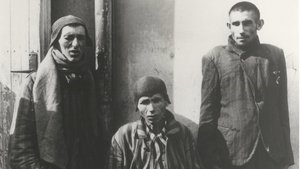
Forty years ago, Allied troops invaded Germany and liberated Nazi death camps. They found unspeakable horrors which still haunt the world's conscience. Frontline presents the world broadcast of a 1945 film made by British and American film crews who were with the troops liberating the camps. The film was directed in part by Alfred Hitchcock and is broadcast for the first time in its entirety on Frontline.
You go to rent an apartment and are turned down without any obvious reason. Then you find out your name is in a computer file of undesirable tenants and every other landlord in the city has access to the information. Correspondent Robert Krulwich investigates computerized information systems and the issues of privacy they raise.
In 1984, there were more bank failures in the US than at any time since the Great Depression. Correspondent Judy Woodruff investigates one of the largest banks that failed, Penn Square in Oklahoma City, and another which nearly failed, Continental Illinois in Chicago, to examine the implications on the nation's banking system.